Category: Environment

.
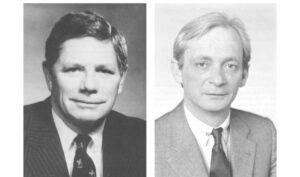
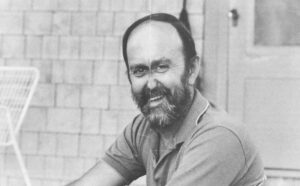
Personality strengths and weaknesses greatly influence decision making in the American pulp and paper/forest products industry. Two key decision-makers are Charles W. Schmidt (L.), senior vice president, Raytheon Corp; and Taggart Edwards (R.), executive vice president, Champion International Corp.

Calling the Shots

Balancing potential human health hazards versus herbicide spraying, bartering long-term forest improvement for needed short-term profits, gambling on untested energy systems–all are complex decisions that reflect the philosophies and styles of the forest industry executives who make them. In 1979, St. Regis Paper Company banned
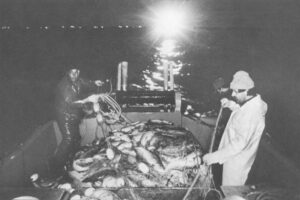
One thousand salmon, six thousand pounds, nine thousand dollars lay on the stern of the Sapphire after the biggest set of their season.

Cowboys of the Sea

Bristol Bay, Alaska–The shallow reach of the Bering Sea crashes between the shoulder and the arm of Alaska’s Aleutian mountain range. The tundra, receding in waves from the ocean, is flecked with small ponds two feet deep. White in winter, pale green in summer. the

Papermaker Bill Burnette, who has worked for 23 years for Great Northern Paper Co. (Ed Note: This picture was badly split over the spine of the issue.)

Mill Town Blues

Millinocket, Maine–For 85 years, all roads around Millinocket have led to the two Great Northern Paper Company’s pulp and paper mills that sit at the edge of Maine’s huge North Woods. Four generations have enjoyed high-paying, cradle-to-grave jobs. Unrestricted hunting and fishing on the company’s

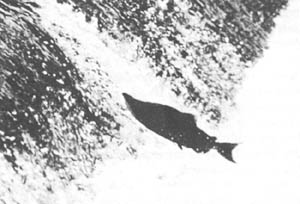
Four years after his life cycle began in this stream, a sockeye salmon returns to start the cycle anew.

Homeward Hearts: A Story of Pacific Salmon

The cool evening breezes have not yet evaporated the remainder of the sweat between the spectators’ shoulder blades. Shielding their eyes from the sun, they stare transfixed at the rushing water before them. “Yea! Looky there.” Twenty-one heads swivel in time to catch a shadow

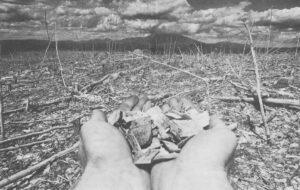
A true clearcut.

Maine’s Faustian Dilemma

Yale University’s David M. Smith, the country’s preeminent silviculturist, once believed it was impossible to clearcut the Maine forest so totally that it wouldn’t immediately renew itself naturally. “I was wrong,” he now says with dismay. “I underestimated the impact that heavy-handed clearcutting with ponderous