
Paris—The experience has unfolded numerous times in America, but for Paris it was a first: the curtain goes up to reveal an empty, darkened stage. Then, rising lights the colors of an acid head’s rainbow begin carving out planes of space in the black neutrality. As the stage turns into a shimmering 3-D cube, a brace of loudspeakers emits a sinuous crackling sound of syncopated static, which stereophonically permeates the entire theater.

From “Imago,” subtitled “The City Curious.”
The cube glows brighter and suddenly figures propelled from some Flash Gordon cartoon strip are sailing airily through its opalescent sectors of crimson and purple. Like motifs blown off of a Miro canvas, bizarre and squiggly, the figures scoot in whirlwinds of color-blurred motion between pockets of darkness and curtains of light, shuttling in and out of existence, disappearing into the smokey blue only to vault a moment later through a wall of peacock green like creatures conjured up from another dimension.
No. The audience wasn’t turned on in the usual sense. Nor is the writer. But there is a kind of aesthetic STP in the air when Alwin Nikolais is in town.
“Total Theater”
Nikolais, the American alchemist of the modern dance, was winding up his company’s first tour of Europe this month at the Sixth Festival International de Danse de Paris—far from his comfortably electronicized home-base in New York’s scruffy lower East Side, where his corps of dancers perform the Connecticut-born choreographer’s special brand of “total theater” at the elegant, little Henry Street Playhouse.
An innovator on a decidedly grand scale, Alwin Nikolais is a major figure in the dance art, where his concepts and techniques have enjoyed a prominent position since the early 50s. His repertoire of some 70 theater-pieces has been commissioned by everyone from C.B.S. and the Spring Mills textile company to dance organizations, universities and “Friends and Enemies of Modern Music.” Awards from Guggenheim and Rockefeller have helped finance his creations—and the ever ambitious span of his scenographic effects.
Last year, the company successfully toured the States. This year, Nikolais won the coveted Dance Magazine Award. “To Alwin Nikolais,” read the citation, “teacher, choreographer, magician of color, light and sound. He has created an exuberant kinetic theatre form and the skilled dancers to bring it to life.”
Knotted Muscles
The magic this Merlin of the dance world practices is compounded of concerns that reach beyond many of the traditions of modern dance—especially the introspective school illuminating Freudian hang-ups with knotted muscles and grimacing lips. There is little needle-pointed Narcissism in Nikolais’ presentations; whatever dark message he tries to convey, it comes scattergunned at the audience in a riot of color and fluid movement.
Brimming with broadcast spectacle—baroque lighting effects, ingenious decor and props, eye-nailing costumes and unsettling synthetic music—Nikolais’ theater reaches beyond the bare-box stage and the confines of the human form to produce a shifting, changing expression of man in his whole world, in contact—or conflict—with his whole environment.
This summer, his own environment was significantly widened by the European tour, which took the troupe to six countries, Italy, Yugoslavia, Germany, France, Switzerland and Sweden. Poland was scheduled but cancelled, partly due to the Russian invasion. Flush with his success, Nikolais and the company have returned to the States to take a tour in various parts of the country. But Nikolais has left his mark here. In Hamburg next month, a Menotti opera will open, with the collaboration of Nikolais and kinetic sculptor Nicolas Schoffer, entitled, said Nikolais with a shudder, “Help, Help the Globolinks.”
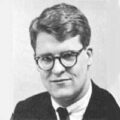
Alwin Nikolais
Much of Nikolais’ popularity derives from the fact that he is a real De Mille of the dance—as much Cecil B. as Agnes in big approach. If big stage seems overloaded with flamboyant artifice, it suits the times. In an era in the arts which has only in the last half decade come to emphasize simultaneity and sensory-overload, Nikolais has been following his own multi-media program for years.
The “exuberant kinetic” quality of big creations are a product of big care and appreciation of the independent elements that comprise his dance-theater: the motion, shape, sound, light and color which he carefully blends into a free-flowing interplay, a polyglot language directed at the senses, a dialogue of action and reaction that results when moving dancer and changing light intertwine or a jolt of electronic score seems to jitter through the limbs of the dancers.
In “Imago,” an electronic score tips the dancers to and fro
The many moods and motifs of Nikolais’ works all share an aspect that marks them as modern: as in most of the current plastic arts, his content is his form. The meaning is in shape and motion. Like a line in a painting by Georges Mathieu, a dancer may travel with a steady stride, then abruptly explode into a flurry of fast, flailing movements. To anyone who has ever seen films of the flamboyant Mathieu painting, the movement he executes may be as important as the streaking brushstroke he lays on. He looks like he’s dancing with his picture surface, and his brush is handled almost like a prop.
Motion Tools
The association comes to mind because Niko1ais employs props as major elements in his works. Capes, poles, elastic bands, reflectors, portable lights, surreal extensions of the dancers’ arms of fabric, metal or paper, great billowy drapes that become part of the decor as dancers manipulate them, all these are conscious projections of the dancer’s frame and become integral to the movement described with them. Nikolais finds that such props help the dancers extend themselves as producers of new or different motion. They are, in this sense, instruments of space production—motion tools—part and parcel of the human hieroglyphics etched out in the colored space of the stage. They also lend a measure of subconscious reality to Nikolais’ expression of the human community, since man goes through life not empty-handed but surrounded by a host of things.
Light Ballet: In “Somniloquy,” dancere are bathed by kaleidoscopic patterns.
The costumes and props Nikolais designs give his dancers an odd, otherworldly look—exactly the effect he wants. His decor and lighting possess a similarly surreal quality; they are like few sets you have ever seen on the dance stage. At times, they almost overpower the dancers that move among them. Nikolais seeks to create the sort of unsettling environment—for his dancers just as much as his audience—which will free his performers from the familiarities of the traditional dance stage, whether they streak off into imaginative orbits of invention or just loosen up. A visit to any securely decadent New York discotheque proves out the wisdom of Nikolais’ long-time method; most of the kids seem to leave their old, inhibited skins at the door once they hit the multi-media crush.
Bounce, Bend, Diffuse
Nikolais’ lighting is recognizably more than the usual stage lighting, quite obviously the difference between a 100-watt bulb and a Tiffany lamp. Behind its lushness and transformations are a brigade of “souped-up” slide projectors and hours of painstaking work on creating the slides and patterns that animate the Nikolais stage. Ultra violet—as well as ultra-violent—light, curtain-walls of light that hang like lime ice-cream, sweeping waves of gem-sparkling tachist illumination figure in these dance pieces. Choreographing the light is one of Nikolais’ larger jobs. Watching him at a rehearsal, composing-as-he-goes in a kind of color-mixing process, reminds you of a painter trying a dab and a line here and there, then backing off to view the effect.
Sometimes, the dancers carry portable lights (finding a small, powerful but unobtrusive battery is one of Nikolais’ major quests), which gives an obvious fluidity, both in color and direction. Scrims and reflectors bend, bounce, diffuse and extend the lighting; motorized set pieces generate a kinetic form and motion of their own while the light works on them. Finally, the costumes—themselves highly colored—and their addenda of props produce a counterpoint of hue and movement.
Sonic Chisels
If light and motion make up plastic elements of this display, sound also scoops out its own atmospheric design in the Nikolais production. Here, too, the choice of a synthetic score becomes a factor of getting away from the familiar—avoiding the kind of music that lends itself to traditional associations. And, anyway, romping violins would not quite make it as a counterpoint to the visual action onstage. The “other world” is definitely present musically since Nikolais composes his scores electronically, with concrete sounds, prepared instruments, percussives or voice transformations. You sit there, inundated by the pings, bonks, shivery, glissando sounds, the intergalaxial burps and belches, and it feels as if little sonic chisels were working away on the mountain of your desire to hear some good old Vivaldi. Sit there long enough and you can feel the ancient prejudices flaking off and tumbling down.
Substance & Shadow: Two faces of the Nikolais dance theater. Inside elasticized costumes, dancers describe an abstract sculpture of shate in “Masks, Props and Mobiles.” Between: Two visually Wagnerian moments in the highly symbolic “Tent” mount lush colors for primitive rites—with possibly a mushroom cloud hinting at problems to come.
In earlier pieces, Nikolais used compositions by Pierre Schaeffer and Harry, Partch; now, he composes all his own scores. Anyone cognizant of the range of electronic or synthetic sounds needs no description of the varying moods they can call up. While the music seems not always inspired in his productions, it does—even to the untutored ear, or perhaps more so—usually “fit” the onstage swirl of movement and color as Nikolais scores it. The synthetic composer works with a highly personal language anyway, but here the “abstract” quality suits the artist’s intention. A good measure of that art is Nikolais’ ability to connect movement and light, sound and movement, color and sound, etc.
Aha, A Doctored Cello!
It’s for people who listen to this music and say, “aha, a doctored cello chord” with an edge of triumph that I put abstract in quotation marks. To most practitioners of the modern plastic or performing arts, “abstract” isn’t a very exact word. One watches dancers in Nikolais’ productions, but even that is not a very exact word. What they are trying to do, in part, is to avoid doing the classic movements we normally associate with “The Dance.”
The attempt is part of the modern arts catechism, and represents a shift from expression tailored to audience-consumption—to a kind of aesthetic research. The choreographer is not trying to find a suitable movement to express a specific emotion or narrative line he has in mind. Rather, he is trying to formulate a method eliciting new kinds of movement, which are not hangovers from years of dance tradition. As in Method Acting, the results can be very boring if experiments, rather than concluded research is presented on stage. This Nikolais usually avoids.
Costumes & props in “Imago” and “Vaudeville of the Elements”—WILD!
Bauhaus Brouhaha: Costumes by Schlemmer and “Glastanz” still
Good as he is, Nikolais isn’t the first artist, of course, to use the elements he blends in his theater. Two associates, Martha Graham and Hanya Holm used electronic music early in their works. The artists of the Bauhaus, notably Oskar Schlemmer, concocted costumes and effects similar to Nikolais’ for his own brand of theater. In the photographs above, which figure in a recent German exhibition of Bauhaus works, the relation to Nikolais’ creations is striking. The emphasis on radical movement, lighting, costume, masks, and decor are evident when photographs of both periods are compared. Other dance figures, Balanchine for example, farms some of the same aesthetic pastures as Nikolais, as does Merce Cunningham. The Judson Memorial Church group is a good deal farther out than Nikolais, and infinitely less disciplined. The photographs on page four suggest the high degree of innovation Nikolais brings with his sense of the grandly flamboyant: “motion invention” vies with almost Wagnerian operatic gesture. A recurrent theme: commercial reality often exploits the best instincts of the arts—light-shows by America’s Usco group or the luminal pyrotechnics at Andy Warhol’s New York discotheque rival the flare of a Nikolais production. In Paris, les spectacles at the Crazy Horse Saloon or Le Sexy (ahem) definitely extend the aesthetic limits of the dance-theater. All this simply to say that Nikolais’ estimable method is approachable from a variety of directions. And that art and commerce are steadily closing ranks.
The changes wrought on the bodies of the dancers, through props, lighting or the way they become part of some large piece of decor they must manipulate (some 12 dancers are required to animate a huge drape in one work, “Tent”)–to witness these transformations is to quickly realize that one is watching “abstraction” only if one insists that the dance must consist of recognizable human bodies in their gray-flannel leotards, doing things we pretty well expect human appendages and torsos to do. What is such a viewer to do when Nikolais bags his dancers in stretch-fabric from head to toe (see P.4), so they look like huge, posturing pieces of Silly Putty?
Armature
This is the sort of non-humanized form and motion sought in much modern dance (the insider buzzword is “motion invention”)–and as it unfolds in front of one’s eyess it is not in the least abstract. It is rather permutations of grace, beauty or motor efficiency that one discovers and comes to appreciate or enjoy. And for those who abhor the “depersonalization” of dance, it should be remembered that the human body is always the armature for this motion-sculpture, the ultimate engine of the dynamic movement, however hidden beneath a glossy exterior.
As do most modern artists, Nikolais uses materials and methods of his own choosing, utilizing U-v light or kaleidoscopic coloring much as a painter might employ a wild new pigment or a Pollock-style method of putting on paint. It is the difference between covering a canvas surface with an all-over network of rhythms and color, or a three-dimensional stage. Going further, Nikolais has always operated somewhat like the Primary Structuralists do, working in forms and shapes denuded of easy associations.
Myth & Symbol
Not that his works do not resonate with a sometimes bewildering flurry of myth and symbol, what he calls “the subterranean and primordial poetry of life.” They do indeed. In “Imago” and “Tower,” both part paean to and parable of the mixed blessings of urban existence, the symbology is fairly literal , built around the rhythms of choked free-ways, crowded streets, a Chaplinesque blend of movements sprightly and sad executed among props (bands, fence-like elements, boxy costumes) that compartmentalize and stand as metaphors for slums and skyscrapers alike.
The piece de resistence Nikolais brought to Paris was “Tent,” which combines and refines many of his effects, motifs and choreography in previous dances. It is his most ambitious work to date, a great, steaming symbolic stew of writhing figures, flashy lighting and lush decor, lashing out in all directions with catspaws of implication over issues large and small. The “tent” of the title (see P.4) is the piece’s unifying symbol—a huge, diaphanous drape that hovers above the dancers, descends around them like a mobile landscape and is whipped up into psychedelic waves by dancers hidden beneath it. It seems a sea of lamentations, or, billowing above them, hints at the mushroom cloud. With their masked heads (and feet at one point) poked through holes in it, the moaning dancers assume a Greek chorus aspect; or with broken postures and drooping faces, a rumor of the death-camp.
Kama-Sutra
But bright spots break through the brooding. Like Abner Dean’s naked people practicing Kama-Sutra positions, the entangled dancers are one point slowly covered by the lowering tent, which sways in a sinister light above their orgy of chaos. When it ascends again, inch by inch, a circle of figures on all fours peer out in silence from underneath like creatures struck dumb with awe at the dawn of creation. But true to form, they are shortly thrown into the frenetic rhythms and tentative flutters that reflect the brassy angst of modern civilization. The shores of primordial creation are quickly left behind for the wary challenges of the neon wilderness.
Ultimate in Rubber-Necking: Masks momentarily posed on their feet, dancers in “Tent” generate a scene that provokes both humor and pain.
My admiration for this creative ferment is not utterly unalloyed. There are times, of course, when even Nikolais’ choreography—or conception—trips over its own flamboyant train. Movements are sometimes just too often repeated without much variation, as if you may not have gotten it the first time. Prop-handling, especially in “Tent” and “Tower,” tends to slacken the pace of the dance and pad the piece with a surfeit of travel. The characteristic inverted Dixie-cup headdress in which Nikolais puts big dancers comes across as a cloying signature after a while. There are areas of microscopy in the fields of biology and medicine, and color-stress photography in industry, that could be explored to expand the effects of the background projections Nikolais uses. Though he has employed movie film in his theater (collaborating with cinematographer Edmund Emschwiller), his work’s dynamics cry out for more. But these are very minor dents in a smooth body of creation that has grown more ambitious and arresting year by year.
Boys In Silver
The dance is an area of the arts in America—and Europe which has been growing faster than most of the others. Troupes are touring more frequently; colleges and universities are extending almost gilded chairs to name choreographers; the government’s arts program may yet necessitate pockets on leotards. From his unprepossessing outpost at the Henry Street Playhouse, Nikolais has contributed tremendously to the progress and popularity of modern dance, helped bring it into another dimension and given a quantum jump to its sensory appeals. Both he and the art have come a long way since he began his career.
“My first appearance,” he has written, “was together with two other boys dressed in silver, representing Connecticut industry, arising from 50 undulating girls, dressed in blue, as the Connecticut river.”
Connecticut industry can be proud. Nikolais’ “total theater” is proving to be a very durable product.
Picture credits: Bauhaus photos, SKO. All others courtesy of Alwin Nikolais.
Received in New York December 2, 1968.
Mr. Oberbeck is an Alicia Patterson Fund award winner, on leave from Newsweek, Inc. This article may be published, with credit to S. K. Oberbeck and the Alicia Patterson Fund.